THE HELP is an obvious, conventional, pandering movie about race relations - but one that reinforces the very stereotypes it hopes to overcome. Yes, the performances are great and the cinematography is beautiful, but I'm going to guess black viewers would be disappointed. Why? Because it only shows blacks as uneducated servants, and the hero of the film is a white woman who courageously crosses the line to help them. The black characters are your cliched "magic negroes," the white racists face comeuppance in ways meant to appeal to white guilt, and it repeats the same joke about putting poop in pie about seven times. Please, can't we for once make a mainstream film about segregation that shows blacks as heroes and individuals, and not have to have a noble white person leading the way?
Sunday, August 21, 2011
I'll Decline THE HELP, Thank You Very Much
It's been a long time since my last post, but what better way to come back than with a scathing review? I saw THE HELP this weekend and had one of my "Why the hell does everyone like this crap?" moments, like I did when I saw similarly overhyped movies like UP IN THE AIR and the unimaginative SLUMDOG MILLIONAIRE.


Monday, November 29, 2010
MISSISSIPPI DAMNED DVD Release!

Congratulations to my friend Tina Mabry, whose multiple award-winning feature film MISSISSIPPI DAMNED is now available on DVD. The film dominated the 2009 independent film circuit, winning top prize at nearly every festival it appeared in, including the Jury Award for Best Feature Film at the 2009 Chicago Film Festival, the Grand Jury Award for Best Feature Film at the 2009 American Black Film Festival, and the Grand Jury Award for Outstanding U.S. Dramatic Feature at the 2009 Outfest Film Festival.
Based on a true story, the film is about three poor black kids in rural Mississippi who reap the consequences of their family's cycle of abuse, addiction, and violence. It's available in a limited pre-sale for only a few more days at http://www.mississippidamned.com/store
The film excels in all areas, featuring gritty storytelling, extraordinary performances from a talented ensemble cast, and surehanded directing. But don't just take it from me, check out some of the praise it's earned:
"The film presents a brutally honest, extraordinary haunting and deeply emotional portrait of a dysfunctional family trying to come to terms with its own tortured legacy." - Ebony Jet Online
"Expertly directed and beautifully shot and scored, featuring unforgettable performances by a tremendous ensemble cast this a film of rare accomplishment."
- indieWIRE
"Raw and powerful...plaudits to filmmaker Tina Mabry for her tightly wound and powerfully explosive story." - The Hollywood Reporter
"Dark, uncompromising, and unflinching, Mississippi Damned is pure power all around." - Edge Magazine
"This riveting ensemble film is one of the most original American debuts I've seen in some time" - Phawker Blog
"This riveting ensemble film is one of the most original American debuts I've seen in some time" - Phawker Blog
"Mabry has put together a stable of actors that make up easily the best ensemble I've seen this year." - Atlanta's Reel Fanatic Blog
"Mississippi Damned is a rare, exceptional film, one that covers enormous amounts of emotional territory and manages to impart sadness and hope in equal measures." - After Ellen
"It is the year's best film. Last year, I sat through all the nominees for Best Film for the Academy Awards and this independent film stands shoulder to shoulder with them. We can only hope that more people are able to view this film on a larger scale across country as it is a story which needs to be told." - The Rainbow Collective
Congratulations Tina!
Monday, November 15, 2010
Debunking the GOP's "tax cut=jobs" BS
The GOP's top priority is extending the Bush tax cut for the wealthiest 2% of Americans, because they argue that it will "create jobs." Here are a number of reasons this is horse shit.
#1 This tax cut has been in place for ten years. If it's such a job creator, why hasn't it been creating jobs all this time? Instead, we've seen thousands of jobs shipped overseas, record deficits, and a widening income gap between the rich and poor.
#2 People go into business to make a profit, not create jobs. Jobs are created when production cannot keep up with demand.
#3 The argument assumes that the wealthy will use the extra income to create jobs, when there's just as much or more reason to believe they'd invest it, spend it, or do any number of things before "Creating a job."
#4 Most job creation by the super wealthy is in underpaid workers overseas, because of #2.
#5 It is middle class consumer spending that has the largest impact on job creation, not the income of the wealthy few. If you really want to kick start the economy, money would best go towards the middle class, who will spend it on things they need, and create higher demand. But in contrast to their passion for giving tax cuts to the rich, the GOP has consistently fought against benefits for the middle class, like extending unemployment benefits.
#6 The tax rate for income above $250,000 used to be 90%, and this was during the prosperous 1950s and 60s. It had no stifling impact on job creation.
The GOP's "tax cut=job creation" is a bullshit reason for them to pad the pockets of the super wealthy, even at a time when more revenue is needed to pay down record deficits, and America's position as a world power is slipping to China. Their agenda is transparently about protecting the wealthiest Americans, even at the cost of country's economic health.
#1 This tax cut has been in place for ten years. If it's such a job creator, why hasn't it been creating jobs all this time? Instead, we've seen thousands of jobs shipped overseas, record deficits, and a widening income gap between the rich and poor.
#2 People go into business to make a profit, not create jobs. Jobs are created when production cannot keep up with demand.
#3 The argument assumes that the wealthy will use the extra income to create jobs, when there's just as much or more reason to believe they'd invest it, spend it, or do any number of things before "Creating a job."
#4 Most job creation by the super wealthy is in underpaid workers overseas, because of #2.
#5 It is middle class consumer spending that has the largest impact on job creation, not the income of the wealthy few. If you really want to kick start the economy, money would best go towards the middle class, who will spend it on things they need, and create higher demand. But in contrast to their passion for giving tax cuts to the rich, the GOP has consistently fought against benefits for the middle class, like extending unemployment benefits.
#6 The tax rate for income above $250,000 used to be 90%, and this was during the prosperous 1950s and 60s. It had no stifling impact on job creation.
The GOP's "tax cut=job creation" is a bullshit reason for them to pad the pockets of the super wealthy, even at a time when more revenue is needed to pay down record deficits, and America's position as a world power is slipping to China. Their agenda is transparently about protecting the wealthiest Americans, even at the cost of country's economic health.
Thursday, November 4, 2010
No, it was YOUR idea
You have to hand it to the GOP's marketing skills. After all, the party of the wealthy few has managed to convince millions of working class people to vote for them and against their own economic interests for years.
In the wake of the GOP's election victories, Mitch McConnell stated that "When the administration agrees with the American people, we will agree with the administration. When it disagrees with the American people, we won’t." How clever. The GOP creates a hyberbolic campaign frightening people about "Obamacare," "government takeovers," and looming tax increases to sell a plan that benefits corporations and the wealthy. Uninformed voters buy into this marketing, and now he claims that whatever the GOP does is just following the will of the American people. Not only that, but he also professes to know what the American people will or won't agree with from the Obama administration.
These guys could find a way to sell garlic to a vampire.
In the wake of the GOP's election victories, Mitch McConnell stated that "When the administration agrees with the American people, we will agree with the administration. When it disagrees with the American people, we won’t." How clever. The GOP creates a hyberbolic campaign frightening people about "Obamacare," "government takeovers," and looming tax increases to sell a plan that benefits corporations and the wealthy. Uninformed voters buy into this marketing, and now he claims that whatever the GOP does is just following the will of the American people. Not only that, but he also professes to know what the American people will or won't agree with from the Obama administration.
These guys could find a way to sell garlic to a vampire.
Wednesday, November 3, 2010
Okay, GOP, What'll It Be?
The Republicans took back the House and most of the Senate yesterday on a message of extending tax cuts for the wealthy, deficit reduction, and cutting spending. But as they take power, it will be interesting to see how they plan on executing that message, because it doesn't add up.
To begin with, it would have been nice if the same outrage over deficit spending emerged when Bush II was waging two unfunded wars, but that's another matter. The problem here is that you can't argue for both extending tax cuts for the wealthy while complaining about the deficit. The Bush tax cuts are responsible for $200 billion of the deficit annually, far more than Obama's stimulus plan.


Similarly, the GOP argues for spending cuts as a way toward deficit reduction. But they only favor cuts in domestic spending, not defense, which accounts for over $300 billion, and not by ending the war in Afghanistan, which is one of the largest impacts on the federal deficit. In the GOP's "Plan for America," they outline $100 billion in domestic spending cuts. Merits of that aside, how would that alone be an answer to the deficit without addressing these larger expenditures?
You won the election, GOP, but now you have to tell us how you'll make sense of your agenda.
To begin with, it would have been nice if the same outrage over deficit spending emerged when Bush II was waging two unfunded wars, but that's another matter. The problem here is that you can't argue for both extending tax cuts for the wealthy while complaining about the deficit. The Bush tax cuts are responsible for $200 billion of the deficit annually, far more than Obama's stimulus plan.


Similarly, the GOP argues for spending cuts as a way toward deficit reduction. But they only favor cuts in domestic spending, not defense, which accounts for over $300 billion, and not by ending the war in Afghanistan, which is one of the largest impacts on the federal deficit. In the GOP's "Plan for America," they outline $100 billion in domestic spending cuts. Merits of that aside, how would that alone be an answer to the deficit without addressing these larger expenditures?
You won the election, GOP, but now you have to tell us how you'll make sense of your agenda.
Friday, September 17, 2010
The Fighter... with no Gatti?
The Fighter, the unimaginatively titled boxing film starring Mark Wahlberg as junior welterweight Micky Ward, will be released in December of this year. Ward is best known for his exciting trilogy against Arturo Gatti, but unfortunately, it will not be included in the film.
Two of Ward's three battles with Gatti were awarded "Fight of the Year" by Ring Magazine. The first was the best, though, with many calling it the "Fight of the Century," and its 9th round dubbed "Round of the Century" by commentator Ernie Shavers. The matchup was intriguing because of its contrast in styles: Ward, the tough body puncher who would march straight in, taking punishment while waiting to land a shot, and Gatti, the faster, more mobile "boxer" of the two. The two men fought at a frantic, desperate pace, both taking a beating and showing great heart. As a viewer, you come away appreciating both fighters. There are more skilled boxers out there, but none have been in fights this entertaining. During the trilogy, the two men became great friends, until Gatti's untimely death (murder?), still under investigation.
Here's a link to the first fight in its entirety:
And for you immediate gratification types, here's the 9th round:
Unbelievable. Excluding these great battles from a film about Ward would seem to diminish its potential, but I'll withhold judgment until I see it.
Two of Ward's three battles with Gatti were awarded "Fight of the Year" by Ring Magazine. The first was the best, though, with many calling it the "Fight of the Century," and its 9th round dubbed "Round of the Century" by commentator Ernie Shavers. The matchup was intriguing because of its contrast in styles: Ward, the tough body puncher who would march straight in, taking punishment while waiting to land a shot, and Gatti, the faster, more mobile "boxer" of the two. The two men fought at a frantic, desperate pace, both taking a beating and showing great heart. As a viewer, you come away appreciating both fighters. There are more skilled boxers out there, but none have been in fights this entertaining. During the trilogy, the two men became great friends, until Gatti's untimely death (murder?), still under investigation.
Here's a link to the first fight in its entirety:
And for you immediate gratification types, here's the 9th round:
Unbelievable. Excluding these great battles from a film about Ward would seem to diminish its potential, but I'll withhold judgment until I see it.
Friday, September 10, 2010
The Greatest of All Time, Sort of
I'm no boxing expert, but I do like ranking things, so I thought I'd compare three heavyweight fighters whom I consider the best of their eras to determine who reigns supreme. I should note, the nominees are just my sentimental favorites, and completely omit the contemporary era as well as the earliests.
The first is Mike Tyson. In his prime, Tyson was a vicious, highly skilled and well-trained fighter, the youngest heavyweight champion in boxing history, who demolished most of his opponents in an average of 3.5 rounds. Tyson was unique because he possessed devastating power, but also lightning fast hand speed. Combined with his punching accuracy, he was an overpowering fighter with animal-like aggression. Here he is, at his peak, taking on undefeated champion Michael Spinks. It must have been a real letdown for people expecting this internationally-hyped heavyweight championship fight to go the distance.
Michael Spinks vs. a Wild Animal:
When Don King took over Tyson's career and fired his original trainer, he stopped bobbing and weaving and using his jab and combinations, instead looking for one punch knockouts. As a result, he started losing, first to Buster Douglas in what's considered the biggest upset of all time. He never got up from a knockdown, and when his fights went into later rounds as they did against Holyfield and Lewis, he became far less dangerous. But Tyson in his prime would have a good chance at beating anyone from any era.
Muhammad Ali was a true "boxer" - meaning he relied on technique and ring strategy rather than going toe to toe with opponents - with incredible speed and agility. A man of great conviction, he proved he could take punishment when he fought Foreman and Frazier, but more importantly, knew how to avoid it. After a long career, the guy's face shows no damage.
A bad, bad man:
Beause he wasn't a power puncher, he relied on flurries of shots to wear down his opponents. His habit of backing up while throwing jabs was a good defensive technique, but also weakened his power. Ali was a gutsy, talented, and intelligent fighter. He was an Olympic champion and won the title three times.
Rocky Marciano was a hard-hitting brawler with incredible stamina. He's the only undefeated champion in heavyweight history, and suffered only two knockdowns during his professional career. Marciano would be a light heavyweight in the modern era, but he had knockout power on par with some of the strongest punchers in history. His stamina meant that he would continously attack opponents, bombarding them from every angle without letting up. Marciano was a relentless warrior who beat everyone he fought to a pulp.
Marciano hurting people:
Marciano could also fight through massive punishment, winning one fight with his nose literally split in half. In an era when fights were allowed to become much more dangerous than they are today, he proved to be a fighter of remarkable toughness. Nearly every fight in the above video would have been stopped much earlier by today's standards.
Marciano's weaknesses included being a wild puncher, not caring what he hit. He also lacked speed, and was a slow starter, with most of his fights going several rounds.
So who's the best? For the sake of this discussion, I'm going to assume we're talking about these fighters in their primes. In Tyson's case especially, after his peak, he wasn't nearly the same fighter. Also, as a disclaimer, I'm not even considering the earlier eras of boxing which would feature Jack Dempsey or Joe Louis.
Tyson vs. Marciano: The key would be the early rounds. If Marciano could survive Tyson's initial onslaught, he would have the advantage in later rounds because of his superior mental toughness. Tyson proved to be weak mentally when really challenged. Tyson is kind of like a scared animal who lashes out violently at first, but whose weak psyche wilts if faced with strong resistance. Marciano is a somewhat sentimental choice, though, and my head tells my that Tyson's movement, power, and accuracy would end the fight early.
Ali vs. Marciano: there was a cool computer simlation done in the 60s that determined Marciano would win. Ali and a then retired Marciano were filmed doing a simulated fight. Afterwards, Ali said that his arms were left bruised from Marciano's punches. It would be a long fight. I'm going to agree with the simulation and go with Marciano for his stamina and guts, wearing down Ali over a long fight.
Ali v Tyson: Ali defeated two of the hardest punchers in history in Foreman and Frazier. I imagine against Tyson, he'd be able to dance and stay away from him in the early rounds. Again, I'd bet against Tyson in a 12-15 round bout.
Tyson was once asked about how he'd do against various opponents from other eras. He replied that without actually having to face them in a fight, one could never really know, a wise answer I think.
The first is Mike Tyson. In his prime, Tyson was a vicious, highly skilled and well-trained fighter, the youngest heavyweight champion in boxing history, who demolished most of his opponents in an average of 3.5 rounds. Tyson was unique because he possessed devastating power, but also lightning fast hand speed. Combined with his punching accuracy, he was an overpowering fighter with animal-like aggression. Here he is, at his peak, taking on undefeated champion Michael Spinks. It must have been a real letdown for people expecting this internationally-hyped heavyweight championship fight to go the distance.
Michael Spinks vs. a Wild Animal:
When Don King took over Tyson's career and fired his original trainer, he stopped bobbing and weaving and using his jab and combinations, instead looking for one punch knockouts. As a result, he started losing, first to Buster Douglas in what's considered the biggest upset of all time. He never got up from a knockdown, and when his fights went into later rounds as they did against Holyfield and Lewis, he became far less dangerous. But Tyson in his prime would have a good chance at beating anyone from any era.
Muhammad Ali was a true "boxer" - meaning he relied on technique and ring strategy rather than going toe to toe with opponents - with incredible speed and agility. A man of great conviction, he proved he could take punishment when he fought Foreman and Frazier, but more importantly, knew how to avoid it. After a long career, the guy's face shows no damage.
A bad, bad man:
Beause he wasn't a power puncher, he relied on flurries of shots to wear down his opponents. His habit of backing up while throwing jabs was a good defensive technique, but also weakened his power. Ali was a gutsy, talented, and intelligent fighter. He was an Olympic champion and won the title three times.
Rocky Marciano was a hard-hitting brawler with incredible stamina. He's the only undefeated champion in heavyweight history, and suffered only two knockdowns during his professional career. Marciano would be a light heavyweight in the modern era, but he had knockout power on par with some of the strongest punchers in history. His stamina meant that he would continously attack opponents, bombarding them from every angle without letting up. Marciano was a relentless warrior who beat everyone he fought to a pulp.
Marciano hurting people:
Marciano could also fight through massive punishment, winning one fight with his nose literally split in half. In an era when fights were allowed to become much more dangerous than they are today, he proved to be a fighter of remarkable toughness. Nearly every fight in the above video would have been stopped much earlier by today's standards.
Marciano's weaknesses included being a wild puncher, not caring what he hit. He also lacked speed, and was a slow starter, with most of his fights going several rounds.
So who's the best? For the sake of this discussion, I'm going to assume we're talking about these fighters in their primes. In Tyson's case especially, after his peak, he wasn't nearly the same fighter. Also, as a disclaimer, I'm not even considering the earlier eras of boxing which would feature Jack Dempsey or Joe Louis.
Tyson vs. Marciano: The key would be the early rounds. If Marciano could survive Tyson's initial onslaught, he would have the advantage in later rounds because of his superior mental toughness. Tyson proved to be weak mentally when really challenged. Tyson is kind of like a scared animal who lashes out violently at first, but whose weak psyche wilts if faced with strong resistance. Marciano is a somewhat sentimental choice, though, and my head tells my that Tyson's movement, power, and accuracy would end the fight early.
Ali vs. Marciano: there was a cool computer simlation done in the 60s that determined Marciano would win. Ali and a then retired Marciano were filmed doing a simulated fight. Afterwards, Ali said that his arms were left bruised from Marciano's punches. It would be a long fight. I'm going to agree with the simulation and go with Marciano for his stamina and guts, wearing down Ali over a long fight.
Ali v Tyson: Ali defeated two of the hardest punchers in history in Foreman and Frazier. I imagine against Tyson, he'd be able to dance and stay away from him in the early rounds. Again, I'd bet against Tyson in a 12-15 round bout.
Tyson was once asked about how he'd do against various opponents from other eras. He replied that without actually having to face them in a fight, one could never really know, a wise answer I think.
Wednesday, September 1, 2010
The Kids Are Damn Good

When I first saw the trailer for The Kids Are All Right, my initial reaction was one of despair. At the time, I was shopping my own comedy spec about a sperm donor who's discovered by his sperm children (in my script, there were 412 of them), and suddenly found myself in a jam. The director who'd attached himself to the project was no longer interested, and I was stuck without many places to go. So for several weeks, I avoided seeing the film, but the buzz was so good I knew I had to see it before it left the theaters.
It turns out that The Kids Are All Right is the best film I've seen all year. I enjoyed Inception, but its lack of character development kept me from becoming strongly invested in the story. The Kids Are All Right has an honest script that lets things play out realistically, flawed characters who drive the story by their choices and mistakes, and an incredible cast. I've never liked Julianne Moore or Mark Ruffalo as much as in this film, and Annette Bening is top notch as usual. And because it's ultimately more about the family than the sperm donor, it's different enough from mine that I still may have a shot. So I forgive you for making a great film.
Tuesday, August 31, 2010
Mark Olson's Gritty Prettiness

Mark Olson, founding member of the seminal alt-country group The Jayhawks, recently released his second solo album, "Many Colored Kite." It's a great album, gentle and beautiful. Admittedly, Mark's nasal, wavering voice and decidedly unslick songs are an acquired taste. But since his days in The Jayhawks, Olson has proven himself to be a premier Americana singer/songwriter.
Mark's music is earnest, unflashy, and favors expression over musicality. His melodies often sound constrained, and he revels in such simplicity that sometimes it's hard to hear a strong melody or musical hook. But when the songs are embellished with harmony vocals, bass lines, or additional instrumentation, the full beauty of his music is revealed. When he was in The Jayhawks, bandmate Gary Louris had the more pleasing lead vocal, but the soul of the band was Mark (which is why The Jayhawks became a mediocre pop band when Olson left). All the same, I think Olson sounds best when paired with Louris or his girlfriend Ingunn Ringvold's crystal clear voice to compliment his gravely sound and bring out the song's hidden beauties. Mark may not have the best voice or delivery, but what he does provide is a rock solid foundation for great songs.
Wednesday, August 11, 2010
The GOP and the Mosque at Ground Zero
 The GOP’s outrage over building a Mosque at Ground Zero is more revealing of their simple-minded bigotry than any accusation I could make. The simple problem with their position is that they equate Islam with Al-Qaeda. Islam is one of the world’s largest religions. Al-Qaeda is a terrorist network. We see this all the time from the GOP though, and there’s a word for it: intolerance.
Certainly, Al-Qaeda would not approve of this Mosque, because they accept no form of Islam other than their own. And for all the GOP’s talk about freedom, what about religious freedom? Typically, they only support freedom when it’s for their own beliefs. But the real indication of freedom is allowing it for people different from yourself.
By the way, there’s already a Mosque at another 9/11 site: there’s one inside the Pentagon.
Friday, March 12, 2010
Prodigal Sons and the Academy Awards

I haven't seen many movies since the beginning of the new year because there really haven't been many I've been interested in seeing, but last night I stumbled across a unique documentary that demonstrates how truth can be stranger than fiction. Prodigal Sons begins as a story about a transexual's return to her rural hometown in Montana, but it becomes more about her relationship with her estranged tragic brother, and explores universal questions of identity, sibling rivarly, and nature versus nurture. Paul was valedictorian, class president, and quarterback of the high school football team, but after graduation, he moved to San Francisco and became Kim. Marc is Kim's older adopted brother, who was held back in preschool, didn't graduate from high school, and suffered a brain injury at 21 that left him severely emotionally unstable. While Kim tries to leave her past as a man behind her, Marc only wants to live in the past, and find out who his real parents are. In one of the strangest twists I've ever seen in film, Marc learns that he's the grandson of Orson Welles and Rita Hayworth. A film about two brothers dealing with identity shifts while hoping to reconnect with each other, this film is continually engrossing and unlike anything you've seen.
The Academy Awards continues to confound me every year. How did The Hurt Locker, a film which is essentially a series of bomb set pieces, win the Oscar for Best Screenplay? Here's a story with no character arc, which blatantly states its theme in the opening credits, and is mostly an exercise in suspense. It also bugs me that people praised the film for NOT making a strong statement about war. Why is that a good thing? Ironically, I think the film actually DOES say something about war, namely that it can make people crazy, so the fact that right-wingers have embraced the movie because they think it doesn't have a political message indicates their frequent inability to understand art. At any rate, I expect a Best Picture winner to be a revelation, which The Hurt Locker isn't. I would have given the Oscar to An Education.
Thursday, February 4, 2010
Dad Unleashed!
I got this e-mail from my father after he watched Inglourious Basterds. I love a fired-up negative review so much, I just had to post it:
Finally watched Inglourious Basterds this week. What an incoherent mishmash of other, better movies (for Nazi parody see The Producers, for undercover silliness see Top Secret, for cinematic conflagration see Cinema Paradiso, for gratuitous and pornographic violence see something else by Tarantino or Peckinpah, for rewriting history, see Fox News or a Republican press conference). Pitt's character was an insulting, simplistic stereotype. I was really put off by using Aldo Ray as the name-inspiration for this guy; Ray was a decent actor who actually served in the Navy in WW2 - a "frogman," predecessor to the SEALs. He saw action at Okinawa (BTW, did you know that this battle resulted in 50,000 US casualties and 100,000 Japanese? Compare to D-Day - 10,000 casualties for all allied forces?). For his war service alone, Ray earned better homage than this crappy movie and cartoon character. Mostly the movie doesn't ever figure itself out. It starts with a credible, tense and terrifying scene, then wanders all over the place and violates its own promise, resorting to gore when it wants to "get serious." Its one redeeming feature is the actor playing the German officer, but his deal-making at the end is totally inconsistent with the rest of his choices. His self-interested choice is more like one a 21st century wall street banker would make. Overall, it seems like something that could have been written and directed by a 15 year old kid just making things up to fantasize an altered outcome for history and have fun with creepiness.
Even though I liked the film, I have to agree with his points. I think I was too entertained to care while watching, but the "eye for an eye" attitude towards Nazis did bother me. And I did question the German officer's deal with Pitt. But now I'm all fired up to do my own crushing review! I've been trying to stick to movies I really like to avoid being negative, but there's nothing like an impassioned, rip-it-to-shreds diss!
Finally watched Inglourious Basterds this week. What an incoherent mishmash of other, better movies (for Nazi parody see The Producers, for undercover silliness see Top Secret, for cinematic conflagration see Cinema Paradiso, for gratuitous and pornographic violence see something else by Tarantino or Peckinpah, for rewriting history, see Fox News or a Republican press conference). Pitt's character was an insulting, simplistic stereotype. I was really put off by using Aldo Ray as the name-inspiration for this guy; Ray was a decent actor who actually served in the Navy in WW2 - a "frogman," predecessor to the SEALs. He saw action at Okinawa (BTW, did you know that this battle resulted in 50,000 US casualties and 100,000 Japanese? Compare to D-Day - 10,000 casualties for all allied forces?). For his war service alone, Ray earned better homage than this crappy movie and cartoon character. Mostly the movie doesn't ever figure itself out. It starts with a credible, tense and terrifying scene, then wanders all over the place and violates its own promise, resorting to gore when it wants to "get serious." Its one redeeming feature is the actor playing the German officer, but his deal-making at the end is totally inconsistent with the rest of his choices. His self-interested choice is more like one a 21st century wall street banker would make. Overall, it seems like something that could have been written and directed by a 15 year old kid just making things up to fantasize an altered outcome for history and have fun with creepiness.
Even though I liked the film, I have to agree with his points. I think I was too entertained to care while watching, but the "eye for an eye" attitude towards Nazis did bother me. And I did question the German officer's deal with Pitt. But now I'm all fired up to do my own crushing review! I've been trying to stick to movies I really like to avoid being negative, but there's nothing like an impassioned, rip-it-to-shreds diss!
Sunday, January 17, 2010
My iHate
I don't ask much of my computer. I don't need it to perform complicated, high end tasks. All I want it to do would seem to be a simple, common need: to transfer music from an iPod to iTunes. Yet, the designers did not include a way to do this, and there seems to be no simple solution without purchasing software from a 3rd party or doing lots of disc-burning. And I'm boiling over with frustration.
Before my old computer bit the dust last year, I moved our iTunes library onto my wife's iPod so we wouldn't lose the thousands of tracks we'd uploaded and purchased. (Okay, I'm really feeling like a sucker for using their branded spellings when their shitty devices cause so much trouble, so from now on I'll just refer to them in lowercase.) I figured I'd simply move the tracks onto the new computer. But I quickly realized Mac does not allow this, presumably to limit illegal file sharing. But every person who buys a new computer will encounter this basic problem. What are they supposed to do when they want to rebuild their itunes library? Moreover, if users don't change their synchronization settings with their new library, itunes will ERASE the files on their ipod when they sync it up, as the new library is empty. It doesn't make sense to have a one-way transfer road when itunes has so much more space and is supposed to be the library. The ipod should be able to move things back and forth as needed, to replace old tracks with new, and to free up space.
Sure, I could leave all the music on the ipod. But what if it runs out of space? What if I want to swap out old music for new? My main problem is that the ipod with all the music is my wife's, while I have my own ipod. (I had to buy a new one after my first one failed, which is another story of frustration. Mac handheld devices are so fragile that if you simply drop one you can't expect it to work again) Until mac provides an efficient way to transfer files from her ipod to itunes, I can't put any of our old library on my ipod, nor move my music off of her device. Believe me, she really loves it when she uses shuffle and a death metal track comes on.
Some users discovered a "back-door" way to copy the music back to itunes. But alas, if you keep up with the itunes updates, this is no longer possible in the new version. However, itunes 9 does provide a way to transfer files from ipod to itunes, PROVIDED YOU BURN THEM ALL TO CD FIRST AND THEN UPLOAD THEM. Like I'm going to do that.
The only other solution I've found is to use 3rd party software I've found online, but unless you purchase the full versions, they only allow transfers of one file at a time. For a library of thousands, that is not gonna work either. Finally, it seems as though Mac will allow transfers of MP3s purchased through itunes, but ultimately this is to their benefit because it encourages users to purchase itunes MP3s instead of CDs. Forcing users to use what I consider an inferior and ever dwindling music format is sad for music itself, but I can talk about that later.
So I'm stuck with our complete music library on my wife's ipod, and only newly added music on mine. I think I'll start carrying around a discman again; at least it functions as one would expect.
Tuesday, December 29, 2009
Catching Up

 Here's a quick catch-up since I haven't posted in a while. Of the movies I've seen in the last few months, here are a few I'd like to comment on:
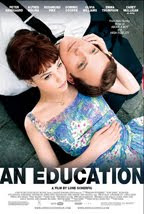
AN EDUCATION (2009, dir. Lone Scherfig)
Based on the memoirs of British journalist Lynn Barber, An Education is a sharply focused coming-of-age drama with excellent performances. Jenny is a culture-hungry schoolgirl pressured by her father to attend Oxford. But when she meets the older and charming David (perfectly cast in Peter Sarsgaard) who introduces her to music, art, and the finer things in life, she thinks she's found a shortcut to getting what she wants and plans to bail on college. The best film I've seen in a while; highly recommended.
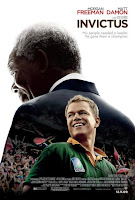 INVICTUS (2009, dir. Clint Eastwood)
Based on the early challenges of Mandela's presidency, Invictus might have been a great film, but it only manages to be a fair one. Mandela's story is certainly incredible: a man jailed for 28 years assumes the presidency and must immediately forgive his captors in order to unify the country. But the film does not focus on this part of his life. Rather, at the time of the film's story, Mandela has already completed his reconciliation, and is trying to teach his fellow South Africans how to do the same. As good as Morgan Freeman is at impersonating Mandela, he's "all dressed up with nowhere to go," as one reviewer put it. Told as a sports story, the film's climax is not as rousing as it should be, as it's hampered by sloppy execution.
UP IN THE AIR (dir. Jason Reitman, 2009)
Very similar to his last writing/directing project Thank You For Smoking, Up in the Air is about a smooth-talker with a heartless job who has trouble connecting with his family emotionally. A very hyped film that's merely an okay one, Reitman's work feels like a feature-length student film: hyper-real with excessive narration and unemotional but cool-sounding stats and figures delivered quickly.
CRAZY HEART (dir. Scott Cooper, 2009)
What's the point? Jeff Bridges is great in the starring role, but Crazy Heart is nearly identical to the 1983 film Tender Mercies, only not nearly as good. Both concern an alcoholic country singer estranged from his child who is taken in by a kind younger woman and her son. What makes the carbon copy even more puzzling is the fact that Robert Duvall, who won an Oscar for playing the country singer in Tender Mercies, is one of Crazy Heart's producers and has a small role in the film. Bridges showcases legitimate country music chops, but the drama of the film feels cliche when compared to Tender Mercies' poetic, Oscar-winning screenplay by legendary writer Horton Foote, who'd previously adapted To Kill A Mockingbird, also featuring Duvall.
Friday, October 30, 2009
They're Coming to Get You, Barbara
 In honor of Halloween, here's a list of guaranteed-scary films if you're looking for something creepy to watch:
Repulsion
Rosemary's Baby
Candyman
Alien
Paranormal Activity (currently in theaters)
These are some of the most chilling films I've seen. I haven't seen tons of horror films, because I avoid the gory and sadistic ones. Torture and explicit gore are NOT scare-inducing. Disgust and nausea inducing, yes, but what's the difference between that and watching open heart surgery? There's very little artisty in cheap shock.
Most of the above films operate on a psychological level. They are about the horror within the mind of the protagonist. Repulsion, one of the scariest, has almost no violence or gore, yet the sense of dread that build is very unsettling. That's true for Rosemary's Baby as well. The delicate Mia Farrow doesn't know if she's going mad or the world around her is, and we are right with her. Candyman is brilliant because it puts the existence of a fictional monster in the power of people's minds: if you believe he exists, then he does. Alien and Paranormal Activity are about the unknown. We know there's something bad out there, but we don't know what it is, or what it's capable of. It's not the things we see in full flesh and blood that are scary, it's what we don't see, lurking out there in the dark...
Tuesday, September 22, 2009
The Church of AC/DC, part 3


THE AC/DC LEGACY
The members of AC/DC are getting old, and probably can't do what they do for many more years, their singer Brian Johnson in particular. Their current world tour marks the first time they have detuned the guitars (only a half-step) in order to make it easier for him to hit high notes. But rumors have that it may be his last tour. Even if they replace him with another singer, it will be the end of an era, and with the rest of the band approaching 60, AC/DC is clearly in its twilight. So what will be their legacy?
The commercial success speaks for itself. Since the band's first LP in 1975, all of their albums have gone gold; most have gone platinum. Unlike other hard rock acts that were big in the 1980s but now tour small club circuits, AC/DC continues to sell out arena shows internationally. They are the second largest-selling band internationally next to The Beatles. Back in Black is the #2 best selling album of all time behind Michael Jackson's Thriller, having sold over 20 million copies. Their success is due to many things. They haven't become a victim of their own success. They haven't sought fame for its own sake. They've lived private lives, marketed themselves wisely, and stuck to their brand.
But critical understanding of the band is lacking. They are often misclassified as heavy metal, not hard rock. Critics usually gloss over them for their apparent simplicity. Even while acknowledging that some of AC/DC's albums are classics of the rock genre, they refer to the band condescendingly, as a second rate act not to be taken seriously. They were not inducted into the Rock and Roll Hall of Fame in their first year of eligibility, which so angered Courtney Love that she demanded the museum return all of the Kurt Cobain artifacts on display (she was also outraged that they panned Lynard Skynard). AC/DC is perceived as dumb and frivolous, merely a low-brow distraction in the rock genre.
AC/DC's incomplete critical assessment may be partly of their own doing. They don't give revealing interviews, they don't engage in a dialectic with their critics, and they tend to embrace comical portrayals of themselves. Ultimately, I think they don't care about their critical reputation.
But the band has also been smeared by people like Tipper Gore, who in the 1980s led an ignorant campaign against rock music considered threatening to youth. AC/DC was made out to be dark, evil, and dangerous. The band was mystified by the accusations, yet the impression has stuck among people unfamiliar with the band. But anyone familiar with them knows AC/DC is about as harmful as Little Richard.
In my estimation, AC/DC has a better fundamental understanding of what rock and roll is than most every other so-called rock band. Amidst all the bland, safe, and self-conscious groups you might find in a record store, there are actually very few who are true rock bands. AC/DC is one of them. If you see them perform live, you cannot help but recognize that these guys eat, breathe and sleep the genre. They may not be able to do anything else, but they do rock as good as it gets. Their fans know this already, and it's why they continue to come out in droves whenever they do a tour and buy up their records. But for AC/DC to have the proper legacy of other highly regarded rock acts like The Rolling Stones, there needs to be more serious critical evaluation of them.
Sunday, August 30, 2009
The Church of AC/DC, part 2

THE SOUND OF BURNING
AC/DC's sound is primarily the sound of two guitars played by brothers Angus and Malcolm Young. Malcolm founded the band in the early 1970s and recruited his younger brother to play lead. The band has seen two vocalists and a number of drummers and bassists in its time, but the one constant has been the Young brothers.
There are a number of famous bands who have had siblings in their line-ups: Earth, Wind, & Fire, Radiohead, Oasis, The Black Crowes, The Kinks, Van Halen, Heart, Iggy and the Stooges, The Replacements, The Beach Boys, The Bee Gees, The Allman Brothers, Creedance Clearwater Revival, The Jackson Five, Pantera, The Breeders, The Jesus and Mary Chain, Stone Temple Pilots, Kings of Leon, My Chemical Romance, and more. I suspect it is the closeness - or in some cases the antagonism - between the siblings that makes them play well together.
AC/DC's guitar sound is shaped by the use of vintage guitars and amplifiers without effects added to the signal loop that would water down the tone. Angus devotedly uses the Marshall JTM45, the same amp popularlized by Eric Clapton's early recordings, which has been called the "holy grail" of guitar amplifiers. These amps achieve distorted tones not through effects pedals, but by turning the volume up to the point at which the signal overloads the circuit. This is natural, organic distortion, which responds to a player's dynamics. It's the sound of the filaments in the tubes being overdriven. It's the sound of things burning, and it is a rich, warm, natural sound.
There's another "burning" element to the band's sound, and that's the voice of the singer. Brian Johnson similarly pushes his voice beyond normal to the point of distortion. When he sings, you are listening to something being destroyed. Like the filaments in the amplifiers, a resource is being expended in order to create a sound.
AC/DC is often described as writing "power chord" riffs, that is, chords played in a set hand position that can be moved around the neck of the instrument. But actually they use open chords, played at the bottom of the neck, which make use of open, ringing strings. The sound between the two is quite different. Power chords sound thinner, but open chords sound "wider." The sound of open strings on a guitar maximizes what a guitar sounds like. It's the truest, least obstructed use of a guitar's resonance.
Angus' lead playing is mainly blues-based. While his schoolboy uniform gives him the image of an irreverant juvenile, his lead playing is actually tasteful, melodic, and phrased. He always plays to the song, rather than use the song as a vehicle for a solo. His vibrato is refined and his note bending is well-intonated, yet it does not sacrifice any rawness. He often allows for a natural voicing of the amplifier's tendancies, rather than try to erase all accidental noises and mispicking. And unlike other elite rock guitarists like Eric Clapton and Jimmy Page who have lost the edginess in their studio work in recent years, Angus has continued to put blistering solos to tape.
Friday, August 28, 2009
The Church of AC/DC

INTRODUCTION
There's no occassion for writing this, other than I have given a lot of thought to this band - probably more than is deserved - and now that I have a blog, I can put it all down in one place.
AC/DC doesn't have ballads. They don't vary their instrumentation. They don't update their sound, follow trends, or change their musical direction. Their drummer plays the same simple 4/4 beat in nearly every song (yet I can't think of any drummer who makes that beat sound better, or who plays it with more care and concentration). In each and every song, they are purely and simply about rocking out. And usually, they hit the mark.
AC/DC has been accused of writing the same song over and over, and they have admitted to it. But isn't that what most artists try? Whether a musician, a novelist, or a director, many auteurs have a singular kind of artistic intent, and try to perfect that intent in every instance of their work. AC/DC's intent happens to be the Platonic form of rock.
AN EAR-OPENING EXPERIENCE
I can mark the exact hour and day when my opinion of AC/DC changed. My friend Mike and I were in a record store when 100 tickets to AC/DC's upcoming show in Charlotte were released early. Being a fan, Mike insisted we buy them since it was guaranteed we'd get great seats, and I figured I might as well go if I could see a famous band up close. We were second in line and got seats in the middle of the second row. It was cool, but I didn't have any expectations I would enjoy the concert beyond having great seats.
It was January 13, 1996 when AC/DC played the Charlotte Coliseum on their "Ballbreaker" tour. Mike and I sat at the very front of a 20,000 seat audience. I can remember how amazing all those people looked behind us, virtually the same view the band would have as they're playing. After the opening band finished, there was a huge set piece with a wrecking ball that knocked over the stoned facade of a building, and AC/DC walked out on stage. The drummer clicked four slow quarter notes on the high hat, and the band started playing "Back in Black."
I was 18 years old in 1996. I'd seen a few concerts, and have seen many since. I played electric guitar and, at the time, was a passionate fan of shredder guitarists (guys who were very technically proficient on the instrument, but usually not good songwriters) mainly because I thought classical music was better than anything, and erroneously thought all music should aspire to the same level. As a result, I wasn't into bands whom I thought were simple rock bands. But when these guys came out on stage and started playing their simple rock songs, an involuntary smile crossed my face. I was witnessing soulfully played rock and roll in its purest form, and it got me. The band delivered a divine groove with sincerety and warmth. They weren't about showboating, or trying to impress, or enjoying their own superstardom. They were about rock and roll. I could see it up close, on their faces. They loved playing this stuff, and it was contagious. They were endearing in their shamelessness. It was sincerely delivered, and a whole lot of fun.
I stood the entire show. Even though I didn't own any of their albums, I somehow knew every song. The setlist was a crowd-pleasing collection of their greatest hits. There was no egotistical posturing, no self-indulgent performances of obscure tracks. The band had a blue collar attitude that they were supposed to put on a show for the ticket-buying audience. I realized that what I thought were stupidly macho lyrics were really just tongue-in-cheek irreverant fun. What I had believed were boring riffs communicated clearly and mightily when played at a high volume. And what I'd considered old-fashioned, out of touch music was really bluesy, universally familiar, and irresistibly timeless songwriting. AC/DC was a feel-good groove band whose drummer smoked cigarettes as he played.
After the show, I was in a bliss. I hated to admit to myself that this was a better show than the Metallica concert I'd seen just a few months ago. Metallica was my favorite band at the time, but I'd just been introduced to a band whom I'd eventually come to love and respect much more. And it was all because I happened to be in the right record store at the right time.
In future posts on this topic, I'm going to go a little academic on AC/DC and start analyzing them...
Friday, August 21, 2009
The Last Great Film I Saw Was...
 It Might Get Loud, 2009, dir. Davis Guggenheim.
http://www.imdb.com/title/tt1229360/
It Might Get Loud celebrates the glory of rock guitar by gathering three generations of players - Jimmy Page, the Edge, and Jack White - to talk music and jam. In lesser hands, this documentary might have become self-indulgent and meandering, but Guggenheim organizes the footage of their backstories, jam session, and live performances so well that it's an absolute dream for fans of rock guitar.
Unlike other music documentaries, we hear the stories behind the music directly from the artists themselves. We watch as The Edge rediscovers a 4-track demo of Where the Streets Have No Name. We see Page giddily play air guitar along with one of his favorite songs, "Rumble." We go from Page speaking about his predilection for dark and light contrasts to a balls-out performance of "Stairway to Heaven."
The guitars sound incredible, and the music is mixed really well. Seeing newly-mixed concert footage of Led Zeppelin in a movie theater alone is worth the price of admission. But the careful editing keeps the film moving forward, and provides philosophical contrasts and commonalities by switching off between the three subjects. Jimmy Page steals the show as the vanguard of rock, comfortable in his old age to happily open up and storytell. Jack White can become tiresome because he's constantly putting forth an image of himself, but that may be because of his youth and the fact that unlike the other two, he has yet to carve out his own artistic legacy (he spends most of his time talking about influences and whom he tries to imitate). But even he is unable to contain his joy as he watches Jimmy Page play the riff to "Whole Lotta Love," one of the film's priceless moments. The powerful and selective use of concert footage, the thoughtful organization of artistic philosophies, and the spontaneous moments of a rock union make for a great documentary, and it's a tribute to the skill of the filmmakers to take this material and create something insightful, entertaining, and new.
Tuesday, July 28, 2009
THE HURT LOCKER

The Hurt Locker opens with a quote from author Chris Hedges: "war is a drug." Following this unsubtle statement of theme, the film goes on to support the idea that "war is a drug" with skillfull filmmaking, but ultimately lets us down because it doesn't illuminate anything further.
The film is very good. The tension and action are second to none. You couldn't ask more of the cast, especially the wisely- casted unknowns, whose performances are so real you feel like you're watching a documentary. I expect to see Jeremy Renner get a lot more high profile work now after his excellent turn as a cavalier bomb-defuser. The locations and realism of the operations make you believe that this indeed is what things must be like in 2008 Iraq. But while the film achieves what it sets out to do, what it sets out to do isn't that compelling. The film tries to avoid becoming a full-blown story, and keeps us from ever fully knowing the characters, yet it asks us to be there for core emotional moments that are cliches of the war genre: the green soldier who struggles to keep his wits together (see The Deer Hunter for a better example) and the banality of coming home after experiencing the adrenaline rush of combat (also see The Deer Hunter). Saying that "war is a drug" might be a new take on the genre, but through the entire film, we come to understand nothing more than that.
Subscribe to:
Posts (Atom)