Friday, March 12, 2010

Prodigal Sons and the Academy Awards


I haven't seen many movies since the beginning of the new year because there really haven't been many I've been interested in seeing, but last night I stumbled across a unique documentary that demonstrates how truth can be stranger than fiction. Prodigal Sons begins as a story about a transexual's return to her rural hometown in Montana, but it becomes more about her relationship with her estranged tragic brother, and explores universal questions of identity, sibling rivarly, and nature versus nurture. Paul was valedictorian, class president, and quarterback of the high school football team, but after graduation, he moved to San Francisco and became Kim. Marc is Kim's older adopted brother, who was held back in preschool, didn't graduate from high school, and suffered a brain injury at 21 that left him severely emotionally unstable. While Kim tries to leave her past as a man behind her, Marc only wants to live in the past, and find out who his real parents are. In one of the strangest twists I've ever seen in film, Marc learns that he's the grandson of Orson Welles and Rita Hayworth. A film about two brothers dealing with identity shifts while hoping to reconnect with each other, this film is continually engrossing and unlike anything you've seen.


The Academy Awards continues to confound me every year. How did The Hurt Locker, a film which is essentially a series of bomb set pieces, win the Oscar for Best Screenplay? Here's a story with no character arc, which blatantly states its theme in the opening credits, and is mostly an exercise in suspense. It also bugs me that people praised the film for NOT making a strong statement about war. Why is that a good thing? Ironically, I think the film actually DOES say something about war, namely that it can make people crazy, so the fact that right-wingers have embraced the movie because they think it doesn't have a political message indicates their frequent inability to understand art. At any rate, I expect a Best Picture winner to be a revelation, which The Hurt Locker isn't. I would have given the Oscar to An Education.

Thursday, February 4, 2010

Dad Unleashed!

I got this e-mail from my father after he watched Inglourious Basterds. I love a fired-up negative review so much, I just had to post it:

Finally watched Inglourious Basterds this week. What an incoherent mishmash of other, better movies (for Nazi parody see The Producers, for undercover silliness see Top Secret, for cinematic conflagration see Cinema Paradiso, for gratuitous and pornographic violence see something else by Tarantino or Peckinpah, for rewriting history, see Fox News or a Republican press conference). Pitt's character was an insulting, simplistic stereotype. I was really put off by using Aldo Ray as the name-inspiration for this guy; Ray was a decent actor who actually served in the Navy in WW2 - a "frogman," predecessor to the SEALs. He saw action at Okinawa (BTW, did you know that this battle resulted in 50,000 US casualties and 100,000 Japanese? Compare to D-Day - 10,000 casualties for all allied forces?). For his war service alone, Ray earned better homage than this crappy movie and cartoon character. Mostly the movie doesn't ever figure itself out. It starts with a credible, tense and terrifying scene, then wanders all over the place and violates its own promise, resorting to gore when it wants to "get serious." Its one redeeming feature is the actor playing the German officer, but his deal-making at the end is totally inconsistent with the rest of his choices. His self-interested choice is more like one a 21st century wall street banker would make. Overall, it seems like something that could have been written and directed by a 15 year old kid just making things up to fantasize an altered outcome for history and have fun with creepiness.

Even though I liked the film, I have to agree with his points. I think I was too entertained to care while watching, but the "eye for an eye" attitude towards Nazis did bother me. And I did question the German officer's deal with Pitt. But now I'm all fired up to do my own crushing review! I've been trying to stick to movies I really like to avoid being negative, but there's nothing like an impassioned, rip-it-to-shreds diss!

Sunday, January 17, 2010

My iHate

I don't ask much of my computer. I don't need it to perform complicated, high end tasks. All I want it to do would seem to be a simple, common need: to transfer music from an iPod to iTunes. Yet, the designers did not include a way to do this, and there seems to be no simple solution without purchasing software from a 3rd party or doing lots of disc-burning. And I'm boiling over with frustration.

Before my old computer bit the dust last year, I moved our iTunes library onto my wife's iPod so we wouldn't lose the thousands of tracks we'd uploaded and purchased. (Okay, I'm really feeling like a sucker for using their branded spellings when their shitty devices cause so much trouble, so from now on I'll just refer to them in lowercase.) I figured I'd simply move the tracks onto the new computer. But I quickly realized Mac does not allow this, presumably to limit illegal file sharing. But every person who buys a new computer will encounter this basic problem. What are they supposed to do when they want to rebuild their itunes library? Moreover, if users don't change their synchronization settings with their new library, itunes will ERASE the files on their ipod when they sync it up, as the new library is empty. It doesn't make sense to have a one-way transfer road when itunes has so much more space and is supposed to be the library. The ipod should be able to move things back and forth as needed, to replace old tracks with new, and to free up space.

Sure, I could leave all the music on the ipod. But what if it runs out of space? What if I want to swap out old music for new? My main problem is that the ipod with all the music is my wife's, while I have my own ipod. (I had to buy a new one after my first one failed, which is another story of frustration. Mac handheld devices are so fragile that if you simply drop one you can't expect it to work again) Until mac provides an efficient way to transfer files from her ipod to itunes, I can't put any of our old library on my ipod, nor move my music off of her device. Believe me, she really loves it when she uses shuffle and a death metal track comes on.

Some users discovered a "back-door" way to copy the music back to itunes. But alas, if you keep up with the itunes updates, this is no longer possible in the new version. However, itunes 9 does provide a way to transfer files from ipod to itunes, PROVIDED YOU BURN THEM ALL TO CD FIRST AND THEN UPLOAD THEM. Like I'm going to do that.

The only other solution I've found is to use 3rd party software I've found online, but unless you purchase the full versions, they only allow transfers of one file at a time. For a library of thousands, that is not gonna work either. Finally, it seems as though Mac will allow transfers of MP3s purchased through itunes, but ultimately this is to their benefit because it encourages users to purchase itunes MP3s instead of CDs. Forcing users to use what I consider an inferior and ever dwindling music format is sad for music itself, but I can talk about that later.

So I'm stuck with our complete music library on my wife's ipod, and only newly added music on mine. I think I'll start carrying around a discman again; at least it functions as one would expect.

Tuesday, December 29, 2009

Catching Up

Here's a quick catch-up since I haven't posted in a while. Of the movies I've seen in the last few months, here are a few I'd like to comment on:
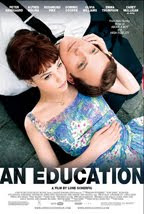
AN EDUCATION (2009, dir. Lone Scherfig)
Based on the memoirs of British journalist Lynn Barber, An Education is a sharply focused coming-of-age drama with excellent performances. Jenny is a culture-hungry schoolgirl pressured by her father to attend Oxford. But when she meets the older and charming David (perfectly cast in Peter Sarsgaard) who introduces her to music, art, and the finer things in life, she thinks she's found a shortcut to getting what she wants and plans to bail on college. The best film I've seen in a while; highly recommended.


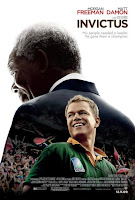
INVICTUS (2009, dir. Clint Eastwood)

Based on the early challenges of Mandela's presidency, Invictus might have been a great film, but it only manages to be a fair one. Mandela's story is certainly incredible: a man jailed for 28 years assumes the presidency and must immediately forgive his captors in order to unify the country. But the film does not focus on this part of his life. Rather, at the time of the film's story, Mandela has already completed his reconciliation, and is trying to teach his fellow South Africans how to do the same. As good as Morgan Freeman is at impersonating Mandela, he's "all dressed up with nowhere to go," as one reviewer put it. Told as a sports story, the film's climax is not as rousing as it should be, as it's hampered by sloppy execution.

UP IN THE AIR (dir. Jason Reitman, 2009)

Very similar to his last writing/directing project Thank You For Smoking, Up in the Air is about a smooth-talker with a heartless job who has trouble connecting with his family emotionally. A very hyped film that's merely an okay one, Reitman's work feels like a feature-length student film: hyper-real with excessive narration and unemotional but cool-sounding stats and figures delivered quickly.


CRAZY HEART (dir. Scott Cooper, 2009)
What's the point? Jeff Bridges is great in the starring role, but Crazy Heart is nearly identical to the 1983 film Tender Mercies, only not nearly as good. Both concern an alcoholic country singer estranged from his child who is taken in by a kind younger woman and her son. What makes the carbon copy even more puzzling is the fact that Robert Duvall, who won an Oscar for playing the country singer in Tender Mercies, is one of Crazy Heart's producers and has a small role in the film. Bridges showcases legitimate country music chops, but the drama of the film feels cliche when compared to Tender Mercies' poetic, Oscar-winning screenplay by legendary writer Horton Foote, who'd previously adapted To Kill A Mockingbird, also featuring Duvall.

Friday, October 30, 2009

They're Coming to Get You, Barbara

In honor of Halloween, here's a list of guaranteed-scary films if you're looking for something creepy to watch:

Repulsion

Rosemary's Baby

Candyman

Alien

Paranormal Activity (currently in theaters)


These are some of the most chilling films I've seen. I haven't seen tons of horror films, because I avoid the gory and sadistic ones. Torture and explicit gore are NOT scare-inducing. Disgust and nausea inducing, yes, but what's the difference between that and watching open heart surgery? There's very little artisty in cheap shock.

Most of the above films operate on a psychological level. They are about the horror within the mind of the protagonist. Repulsion, one of the scariest, has almost no violence or gore, yet the sense of dread that build is very unsettling. That's true for Rosemary's Baby as well. The delicate Mia Farrow doesn't know if she's going mad or the world around her is, and we are right with her. Candyman is brilliant because it puts the existence of a fictional monster in the power of people's minds: if you believe he exists, then he does. Alien and Paranormal Activity are about the unknown. We know there's something bad out there, but we don't know what it is, or what it's capable of. It's not the things we see in full flesh and blood that are scary, it's what we don't see, lurking out there in the dark...

Tuesday, September 22, 2009

The Church of AC/DC, part 3


THE AC/DC LEGACY


The members of AC/DC are getting old, and probably can't do what they do for many more years, their singer Brian Johnson in particular. Their current world tour marks the first time they have detuned the guitars (only a half-step) in order to make it easier for him to hit high notes. But rumors have that it may be his last tour. Even if they replace him with another singer, it will be the end of an era, and with the rest of the band approaching 60, AC/DC is clearly in its twilight. So what will be their legacy?

The commercial success speaks for itself. Since the band's first LP in 1975, all of their albums have gone gold; most have gone platinum. Unlike other hard rock acts that were big in the 1980s but now tour small club circuits, AC/DC continues to sell out arena shows internationally. They are the second largest-selling band internationally next to The Beatles. Back in Black is the #2 best selling album of all time behind Michael Jackson's Thriller, having sold over 20 million copies. Their success is due to many things. They haven't become a victim of their own success. They haven't sought fame for its own sake. They've lived private lives, marketed themselves wisely, and stuck to their brand.

But critical understanding of the band is lacking. They are often misclassified as heavy metal, not hard rock. Critics usually gloss over them for their apparent simplicity. Even while acknowledging that some of AC/DC's albums are classics of the rock genre, they refer to the band condescendingly, as a second rate act not to be taken seriously. They were not inducted into the Rock and Roll Hall of Fame in their first year of eligibility, which so angered Courtney Love that she demanded the museum return all of the Kurt Cobain artifacts on display (she was also outraged that they panned Lynard Skynard). AC/DC is perceived as dumb and frivolous, merely a low-brow distraction in the rock genre.

AC/DC's incomplete critical assessment may be partly of their own doing. They don't give revealing interviews, they don't engage in a dialectic with their critics, and they tend to embrace comical portrayals of themselves. Ultimately, I think they don't care about their critical reputation.

But the band has also been smeared by people like Tipper Gore, who in the 1980s led an ignorant campaign against rock music considered threatening to youth. AC/DC was made out to be dark, evil, and dangerous. The band was mystified by the accusations, yet the impression has stuck among people unfamiliar with the band. But anyone familiar with them knows AC/DC is about as harmful as Little Richard.

In my estimation, AC/DC has a better fundamental understanding of what rock and roll is than most every other so-called rock band. Amidst all the bland, safe, and self-conscious groups you might find in a record store, there are actually very few who are true rock bands. AC/DC is one of them. If you see them perform live, you cannot help but recognize that these guys eat, breathe and sleep the genre. They may not be able to do anything else, but they do rock as good as it gets. Their fans know this already, and it's why they continue to come out in droves whenever they do a tour and buy up their records. But for AC/DC to have the proper legacy of other highly regarded rock acts like The Rolling Stones, there needs to be more serious critical evaluation of them.

Sunday, August 30, 2009

The Church of AC/DC, part 2


THE SOUND OF BURNING


AC/DC's sound is primarily the sound of two guitars played by brothers Angus and Malcolm Young. Malcolm founded the band in the early 1970s and recruited his younger brother to play lead. The band has seen two vocalists and a number of drummers and bassists in its time, but the one constant has been the Young brothers.


There are a number of famous bands who have had siblings in their line-ups: Earth, Wind, & Fire, Radiohead, Oasis, The Black Crowes, The Kinks, Van Halen, Heart, Iggy and the Stooges, The Replacements, The Beach Boys, The Bee Gees, The Allman Brothers, Creedance Clearwater Revival, The Jackson Five, Pantera, The Breeders, The Jesus and Mary Chain, Stone Temple Pilots, Kings of Leon, My Chemical Romance, and more. I suspect it is the closeness - or in some cases the antagonism - between the siblings that makes them play well together.


AC/DC's guitar sound is shaped by the use of vintage guitars and amplifiers without effects added to the signal loop that would water down the tone. Angus devotedly uses the Marshall JTM45, the same amp popularlized by Eric Clapton's early recordings, which has been called the "holy grail" of guitar amplifiers. These amps achieve distorted tones not through effects pedals, but by turning the volume up to the point at which the signal overloads the circuit. This is natural, organic distortion, which responds to a player's dynamics. It's the sound of the filaments in the tubes being overdriven. It's the sound of things burning, and it is a rich, warm, natural sound.


There's another "burning" element to the band's sound, and that's the voice of the singer. Brian Johnson similarly pushes his voice beyond normal to the point of distortion. When he sings, you are listening to something being destroyed. Like the filaments in the amplifiers, a resource is being expended in order to create a sound.


AC/DC is often described as writing "power chord" riffs, that is, chords played in a set hand position that can be moved around the neck of the instrument. But actually they use open chords, played at the bottom of the neck, which make use of open, ringing strings. The sound between the two is quite different. Power chords sound thinner, but open chords sound "wider." The sound of open strings on a guitar maximizes what a guitar sounds like. It's the truest, least obstructed use of a guitar's resonance.


Angus' lead playing is mainly blues-based. While his schoolboy uniform gives him the image of an irreverant juvenile, his lead playing is actually tasteful, melodic, and phrased. He always plays to the song, rather than use the song as a vehicle for a solo. His vibrato is refined and his note bending is well-intonated, yet it does not sacrifice any rawness. He often allows for a natural voicing of the amplifier's tendancies, rather than try to erase all accidental noises and mispicking. And unlike other elite rock guitarists like Eric Clapton and Jimmy Page who have lost the edginess in their studio work in recent years, Angus has continued to put blistering solos to tape.